
Excavation Modelling Case Study:
Kubla Cubed Improves Earthworks Estimating for Corona Excavations
April 2026
Corona Excavations Ltd.
Corona Excavations Ltd is a civil and excavation contractor based in Whistler, British Columbia, Canada. The company uses Kubla Cubed to model complex earthworks, improve estimating accuracy, and communicate excavation strategies clearly to clients prior to construction.
As part of this case study, we spoke with Martin, who walked us through his workflow and demonstrated how Kubla Cubed is used across different stages of his projects. The software supports Corona Excavations in several core areas:
-
-
- Earthworks estimating and bidding
- Cut and fill analysis
- Construction phasing
- GPS-driven site layout
-
Company Profile

Corona Excavations Ltd. operates in a demanding construction environment involving steep terrain, bedrock, frost protection requirements, and strict geotechnical controls.
Location: Whistler, British Columbia, Canada
Industry: Excavation & Civil Construction
Company size: ~50 employees
User Profile
Name: Martin Bell
Role: Surveyor and Estimator / Bidder
Martin oversees estimating, earthworks modelling, and site coordination. His role spans the full project lifecycle, from early bid preparation through to construction.
Key responsibilities include:
-
-
-
- Earthworks and excavation modelling
- Volume calculations
- Cost estimating and bidding
- Client communication
- Site layout and construction execution
-
-

The Challenges: Excavation Estimating Without Clear Visualisation
Limited visibility using traditional CAD workflows
Before using Kubla Cubed, Corona Excavations relied heavily on AutoCAD and spreadsheet-based workflows. While workable, the process was slow and difficult to interpret visually.
Martin noted that the process was “all AutoCAD, clunky and not very visual.” This made it difficult to clearly interpret and communicate earthworks designs clearly to clients.
As a result, it was challenging to:
-
-
- Validate cut and fill strategies
- Model slope and footing requirements accurately
- Clearly explain excavation decisions to clients
- Confidently plan trucking and material logistics
-
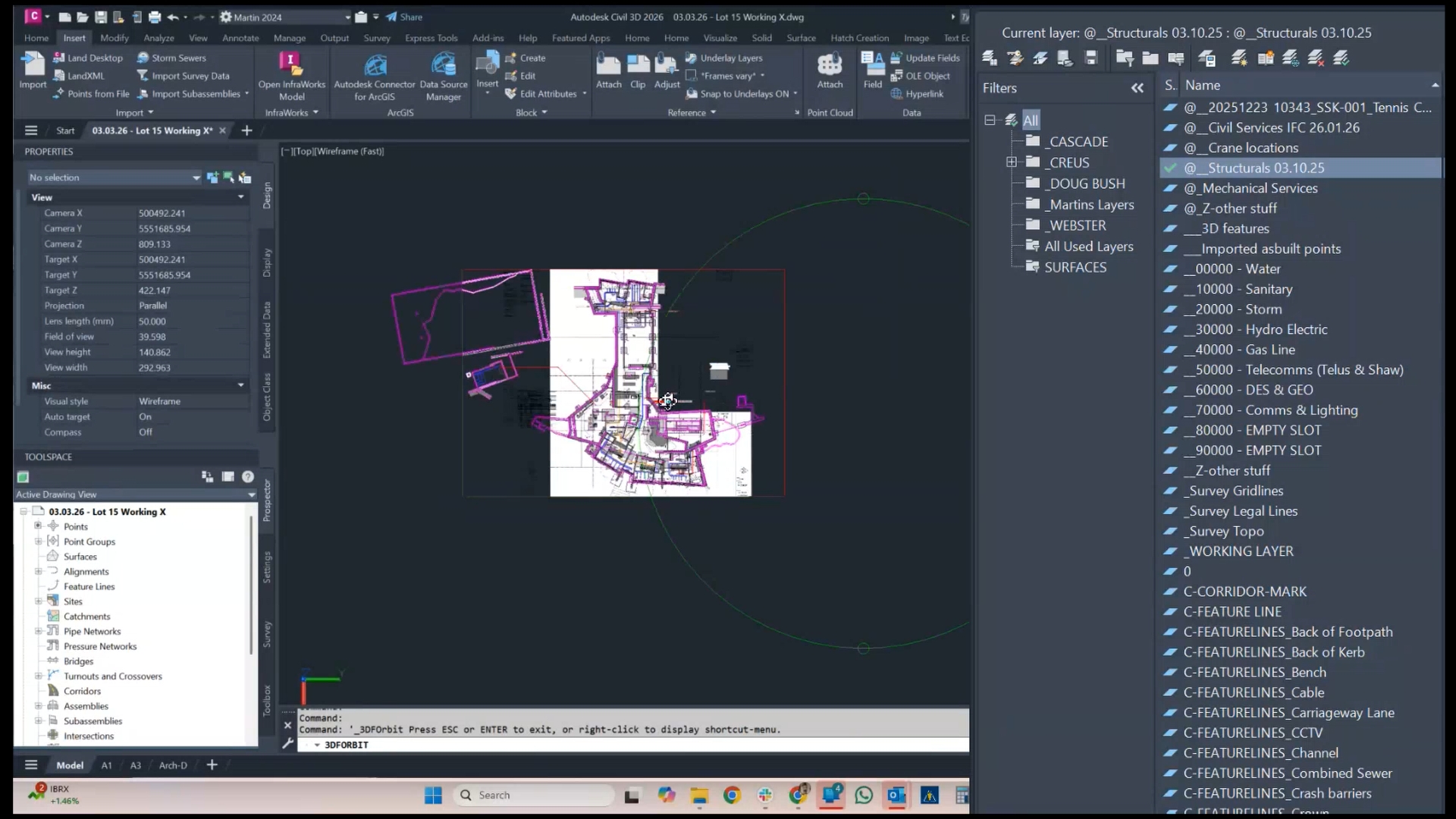
Image: Site Plan in AutoCAD
Avoiding Underestimation in Earthworks Cost and Excavation Planning
A further challenge was managing client expectations around excavation scope and cost. In some cases, clients would select lower-priced competitors without fully understanding the true extent of the work involved.
Martin explained, “Clients assume no material is leaving site. And I’m like, ‘how about we model it and really know?’”
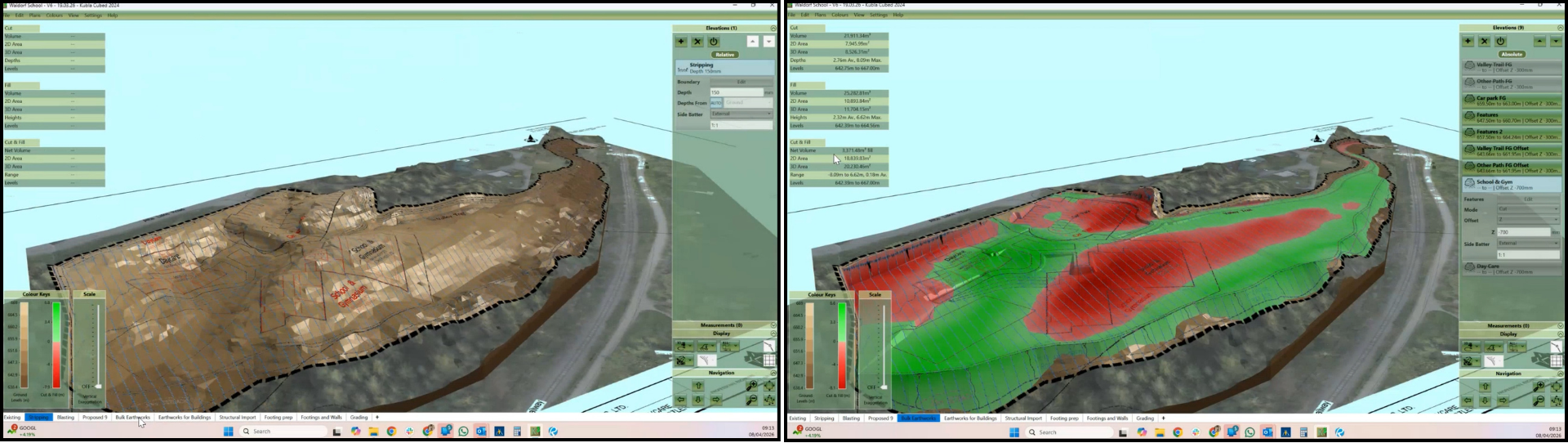
Image: Kubla 3D model comparison – existing vs bulk earthworks with custom shading map
Faster cut and fill?
The Solution: 3D Excavation Modelling with Kubla Cubed
Since adopting Kubla Cubed, Corona Excavations has improved excavation planning, increased estimating accuracy and provided clearer visual communication throughout both bidding and construction phases.
The workflow is typically divided into three stages: planning, estimating, and execution.
STAGE 1: Excavation planning with layered drawings and surfaces
Each project begins by Martin building a model using multiple data sources, including existing topography, architectural drawings, and structural design information.
Typical inputs include:
-
-
- Existing topography imported from AutoCAD (DWG files)
- Survey-accurate TIN surfaces
- Utility plans
- Foundation layouts
- Architectural and structural drawings
-
Within Kubla Cubed, Martin then defines the proposed excavation phases, which may include:
-
-
- Bedrock blasting
- Cut and fill modelling
- Removal of organics
- Structural build‑ups
- Frost‑protected footing coverage
- Service trench depth verification
-
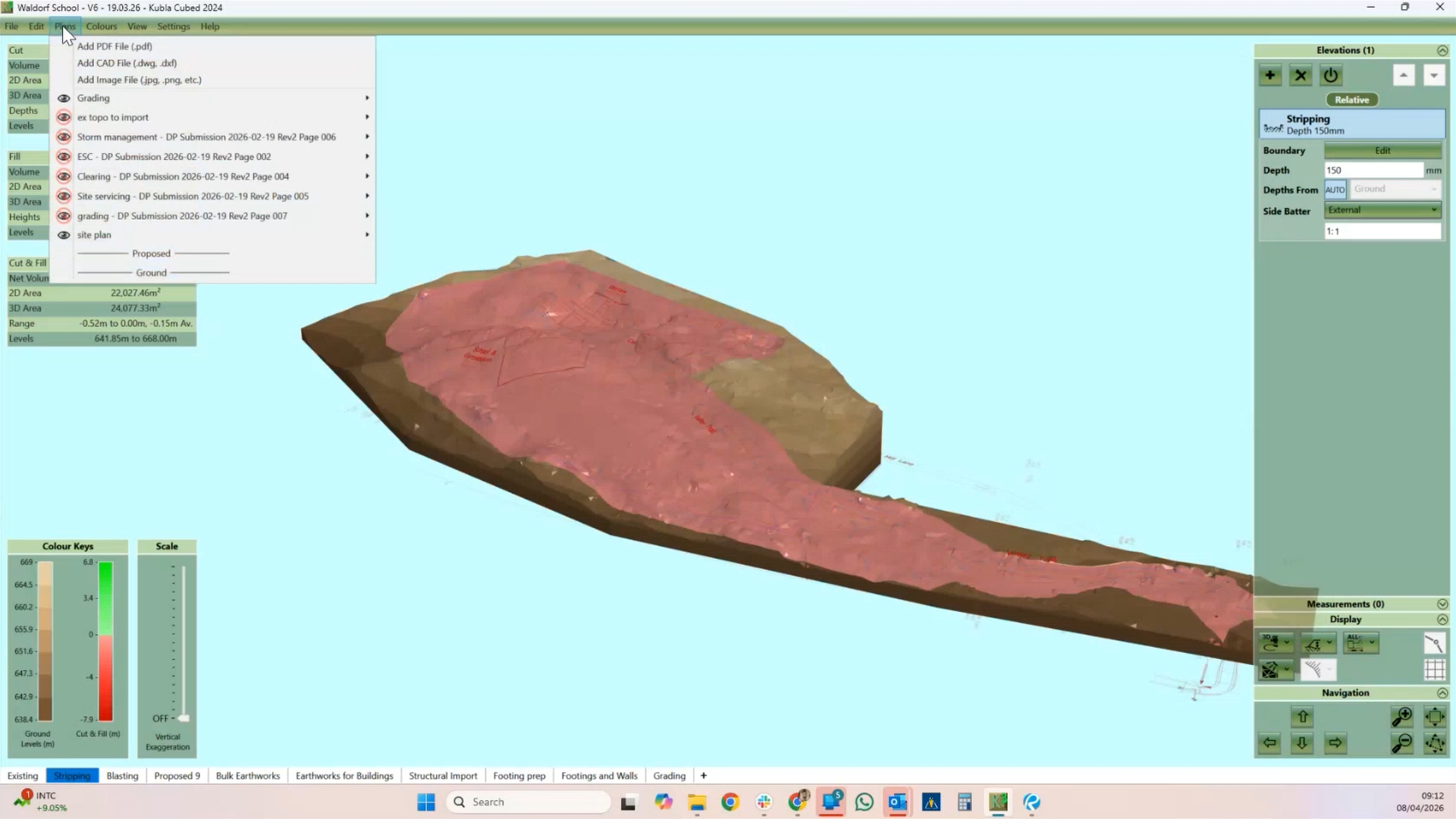
Image: Kubla Cubed 3D terrain model showing layered surfaces listed in the menu and phases in the bottom tabs.
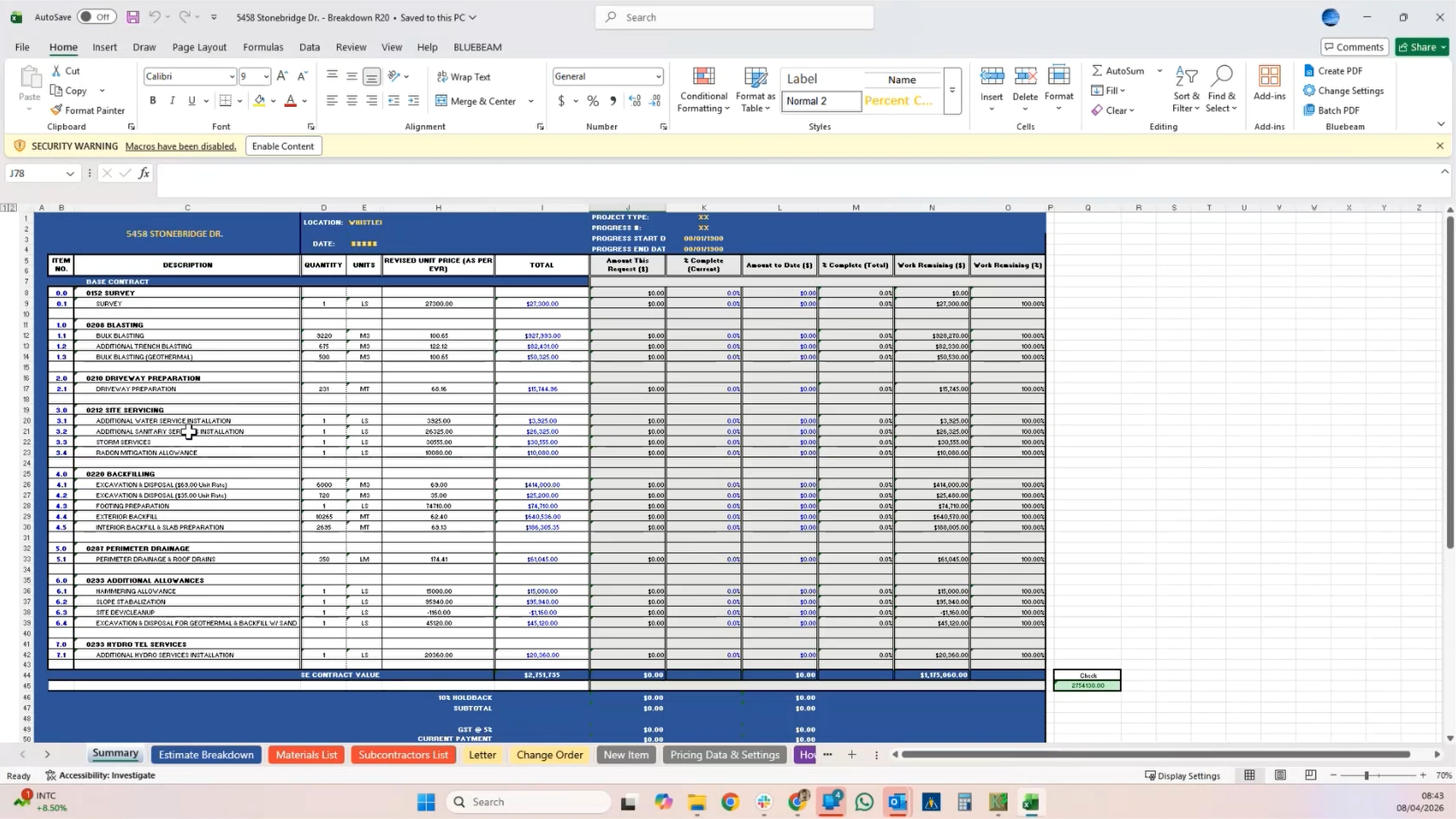
Image: Spreadsheet with costings using volumes from Kubla Cubed
STAGE 2: Earthworks estimating and bid preparation
Once the model is complete, Kubla Cubed volumes are used to support the estimating and tendering process.
Quantities are:
-
-
- Reviewed visually with clients
- Exported into Bluebeam for material markup
- Transferred to Excel for labour, equipment and cost calculations
-
Presenting a 3D model shows we’ve put effort into the workflow of the project before it’s even awarded.
STAGE 3: Construction execution with GPS-ready models
After a project has been awarded, Kubla Cubed models are converted for use in field operations and machine control systems.
The workflow includes:
-
-
- Kubla Cubed surfaces are exported as a CAD file
- Imported to AutoCAD and converted to .TTM files
- Loaded onto Trimble GPS equipment
-
I can be in and out of the job site in five minutes instead of guessing depths.
On-site, dispatch teams track Kubla Cubed-derived volumes to determine:
-
-
- Volume of material delivered to site
- Remaining excavation quantities
- Trucking requirements
-

Ready to Model?
Results: How Kubla Cubed made Measurable Improvements in Excavation Planning
The adoption of Kubla Cubed has delivered clear improvements in efficiency, estimation accuracy and communication across Corona Excavations’ projects.
1. Faster modelling and revisions
Kubla Cubed has substantially reduced the time required to build and adjust excavation models compared to traditional CAD workflows.
As Martin noted:
It saves me about three quarters of the time compared to AutoCAD.
The ability to rapidly iterate models without rebuilding surfaces from scratch has improved responsiveness during both tendering and design development.
2. More accurate cut and fill and trucking calculations
Kubla Cubed enables faster and more reliable earthworks calculations, particularly in complex slope scenarios where manual methods can be time-consuming.
When slope ratios come into play, calculations get time consuming. Kubla [Cubed] can do it on the fly.
This capability supports:
-
-
- Quick comparison of excavation strategies
- Early identification of excessive trucking
- More informed cut/fill balancing decisions
-
In some cases, the analysis also changes construction strategy: “Sometimes balancing cut and fill isn’t beneficial. Removing material can speed up production.”
3. Early identification of service conflicts
By layering and aligning plans in Kubla Cubed makes it easier to spot potential conflicts between services, such as water and electrical lines intersecting or clashing with footings.
Martin explained that when major service conflicts are identified, these are referred back to the relevant design engineers, such as BC Hydro or the civil engineer, for resolution and updated plans.
In other cases, site plans position buildings at elevations that require excavation extents to exceed property boundaries when applying safe slope ratios. This can require either design adjustments or the need for geotechnical approval for steeper slopes.
Client Impact: Clear Understanding and Reduced Risk
1. Clearer excavation visuals for clients
The use of 3D modelling has significantly improved how excavation scope is communicated to clients and non-technical stakeholders.
Clients love the 3D views and cut/fill images
Kubla Cubed helps translate complex earthworks into visuals that improve better decision-making early in the project lifecycle.
Martin explained, “this usually establishes a good trust/bond between ourselves and the client. It reassures them that we are taking into account all aspects of the job and our interests are shared with theirs, we are not solely here to make profit, we want the job to run efficiently and get it done as fast as possible.”
Kubla Cubed is a brilliant visual representation for understanding excavation workflows.
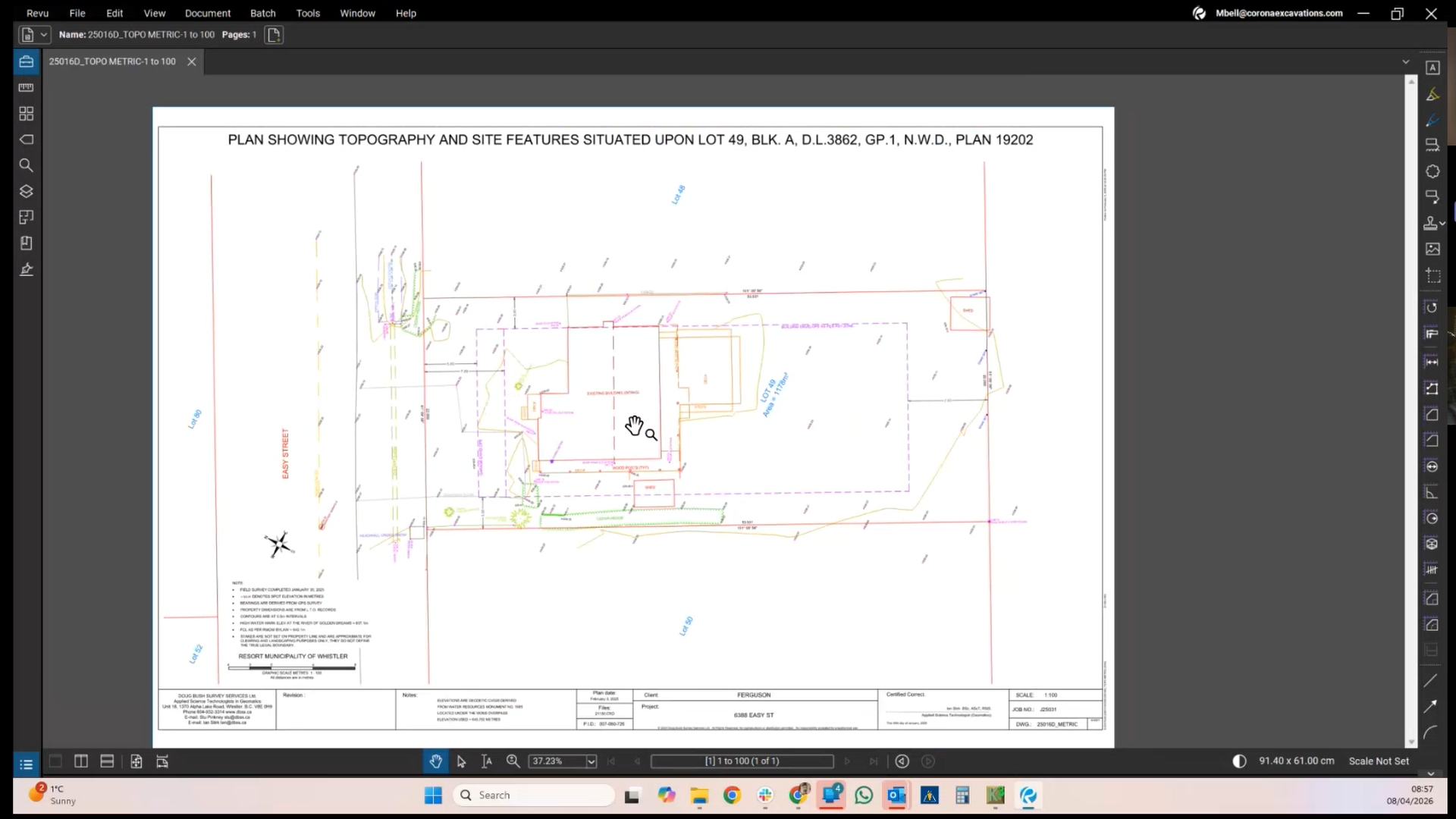
Site Survey
Survey displayed in CAD software
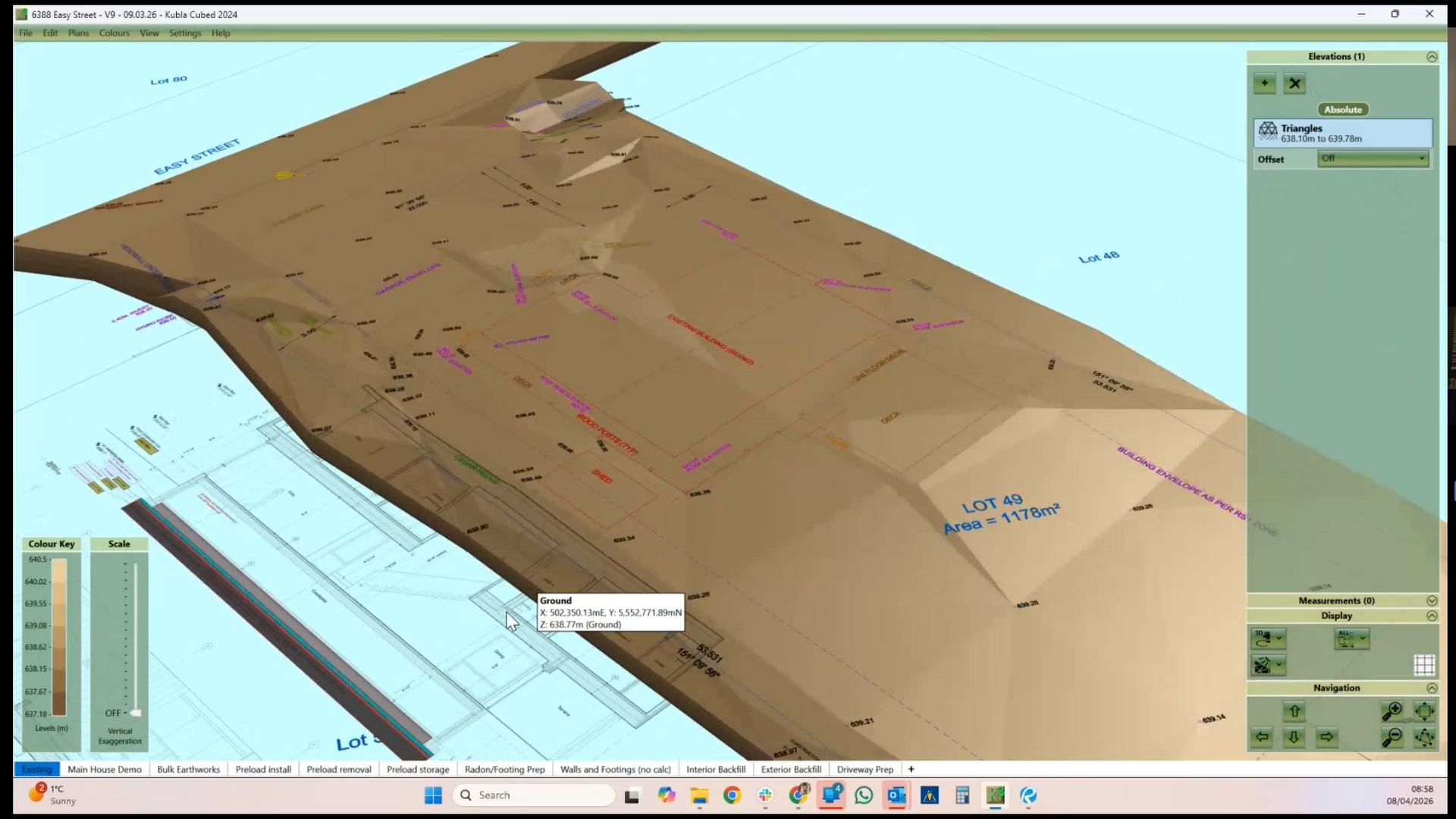
Existing Phase
Existing surface generated from TIN file with site survey plan overlayed
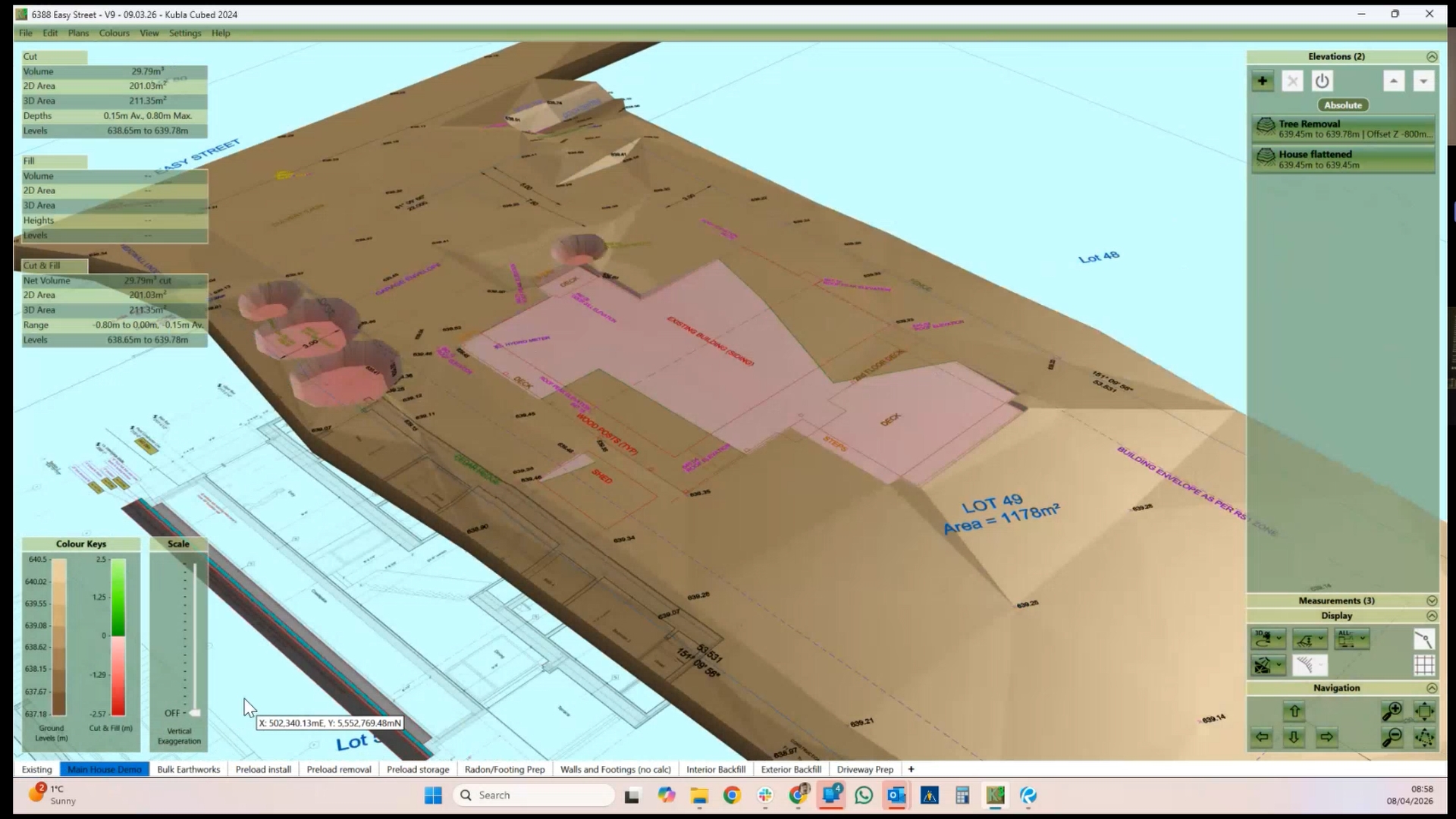
Demolition Phase
Existing building and trees removed.
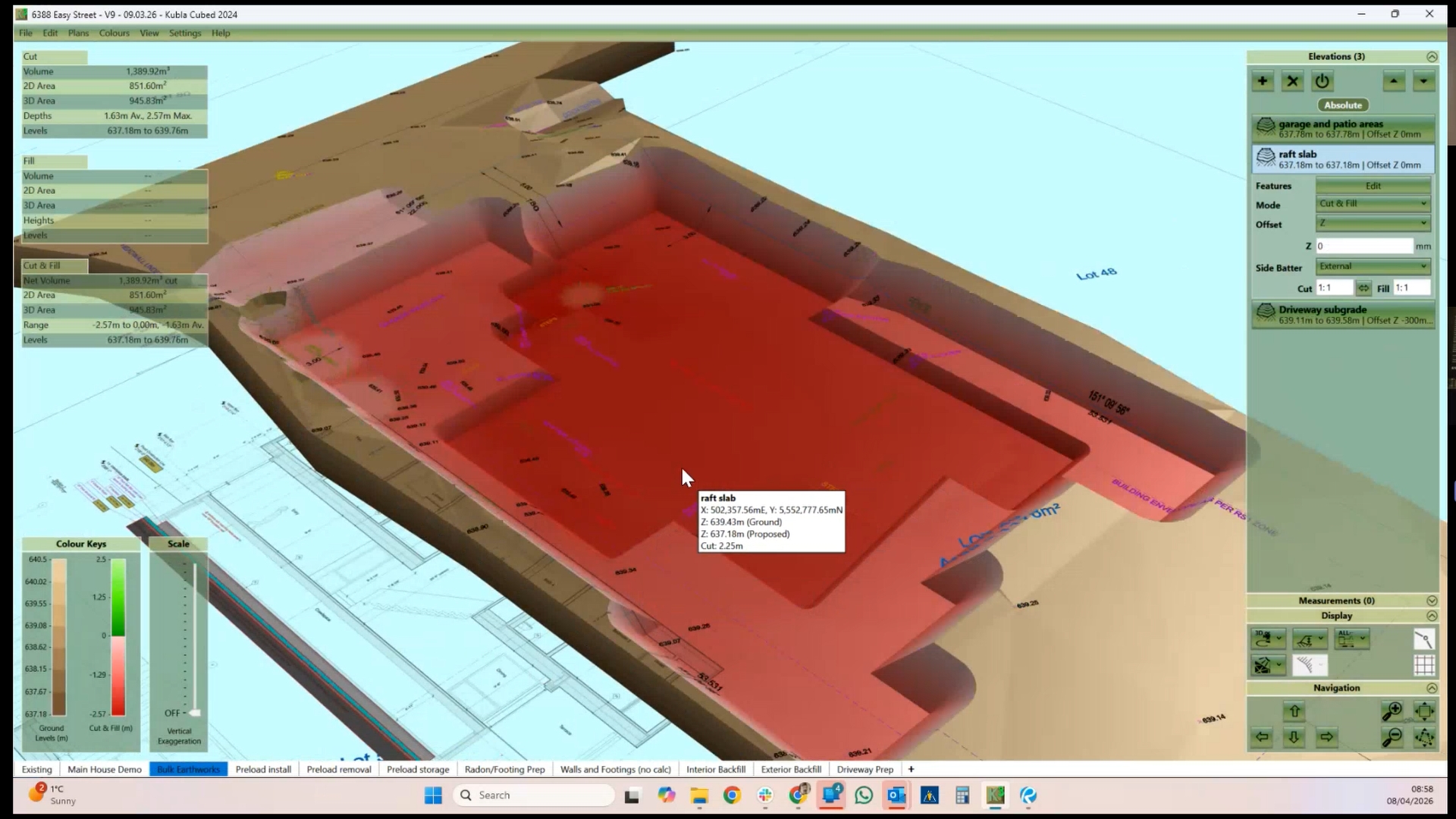
Bulk Earthworks Phase
Feature Surface elements used to complete bulk earthworks calculations
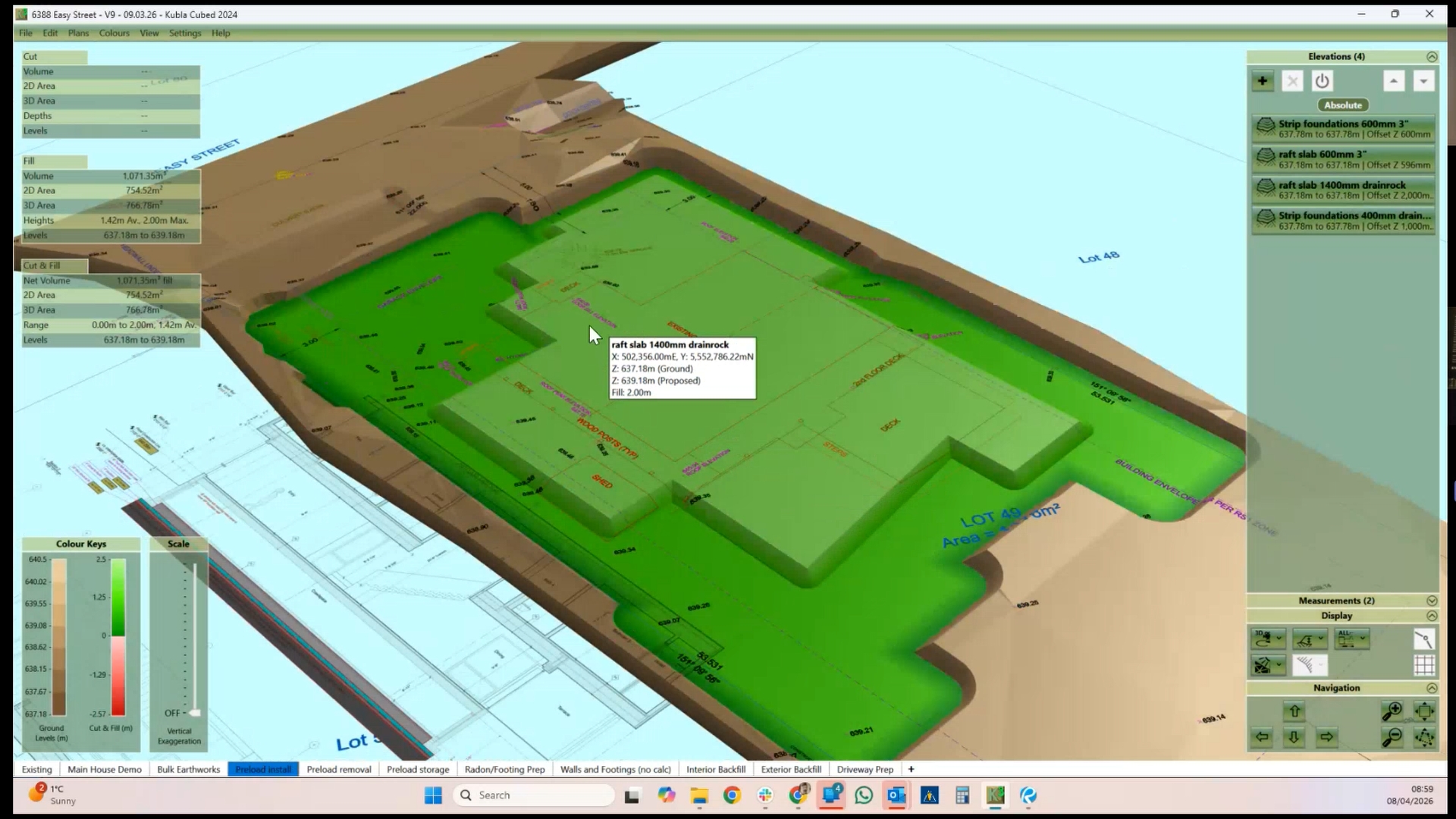
Preload Install Phase
Multiple Feature Surface elements to calculate the fill
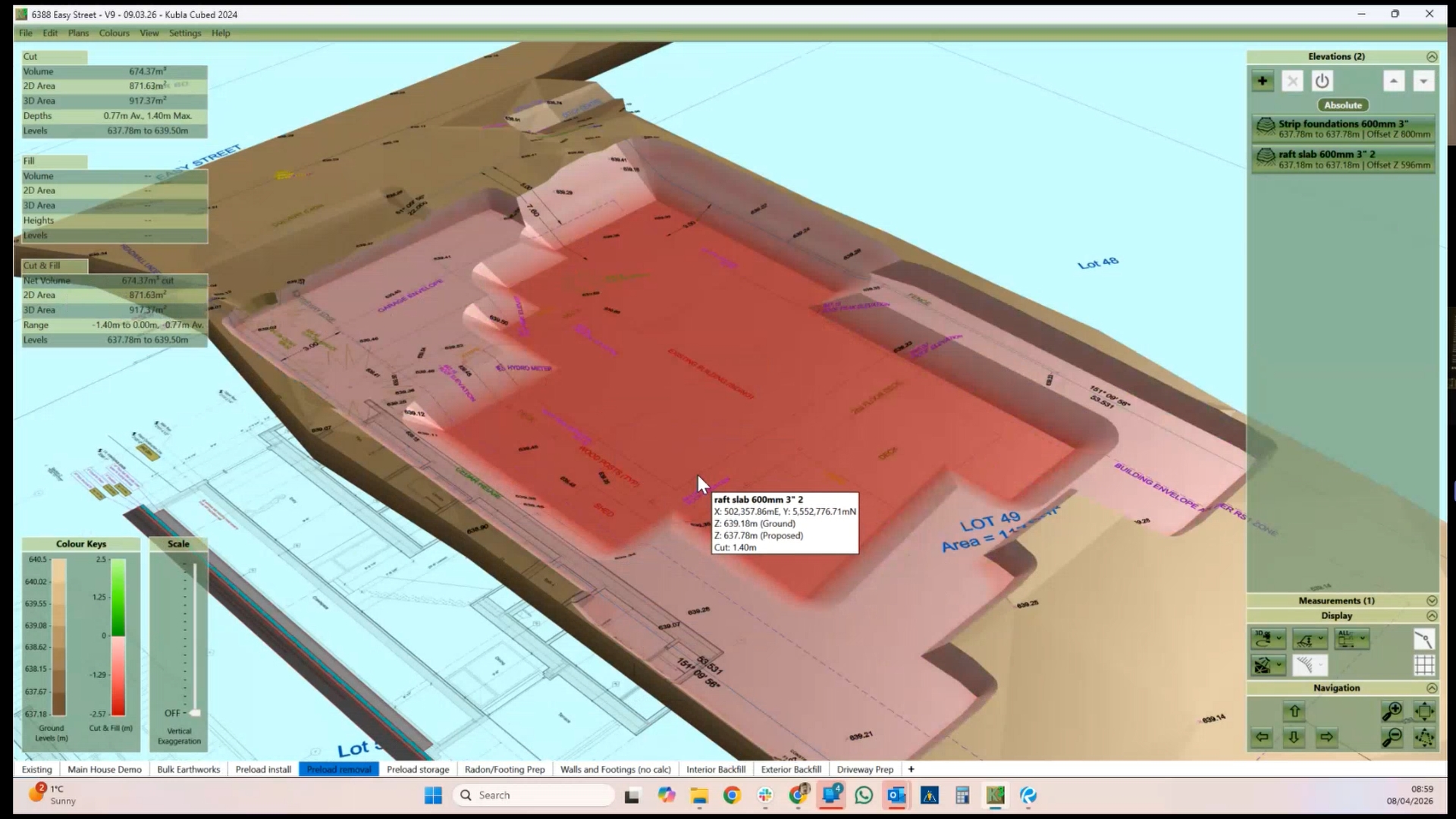
Preload Removal
Cut showing to remove preload
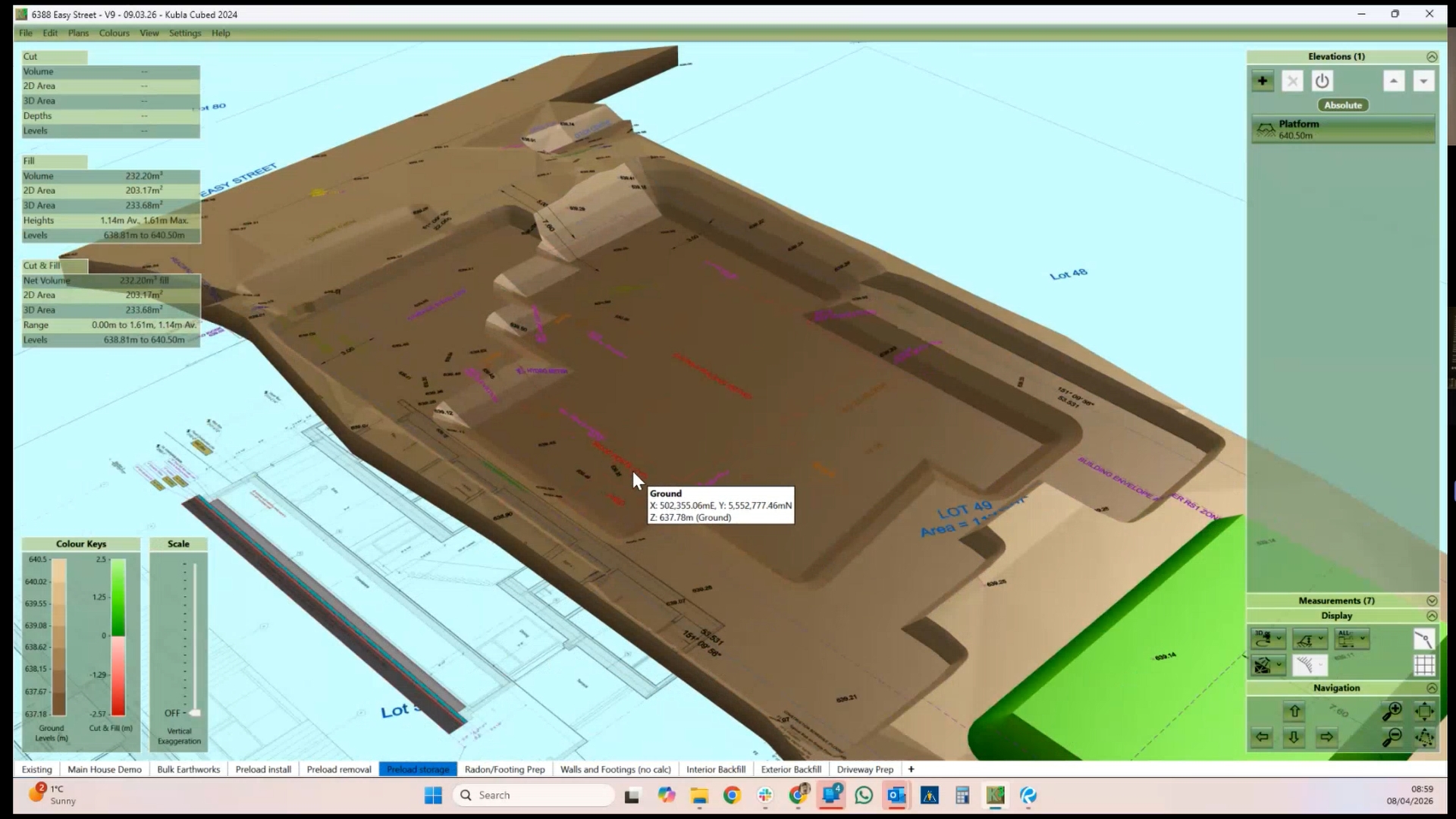
Preload Storage
Platform to define material storage
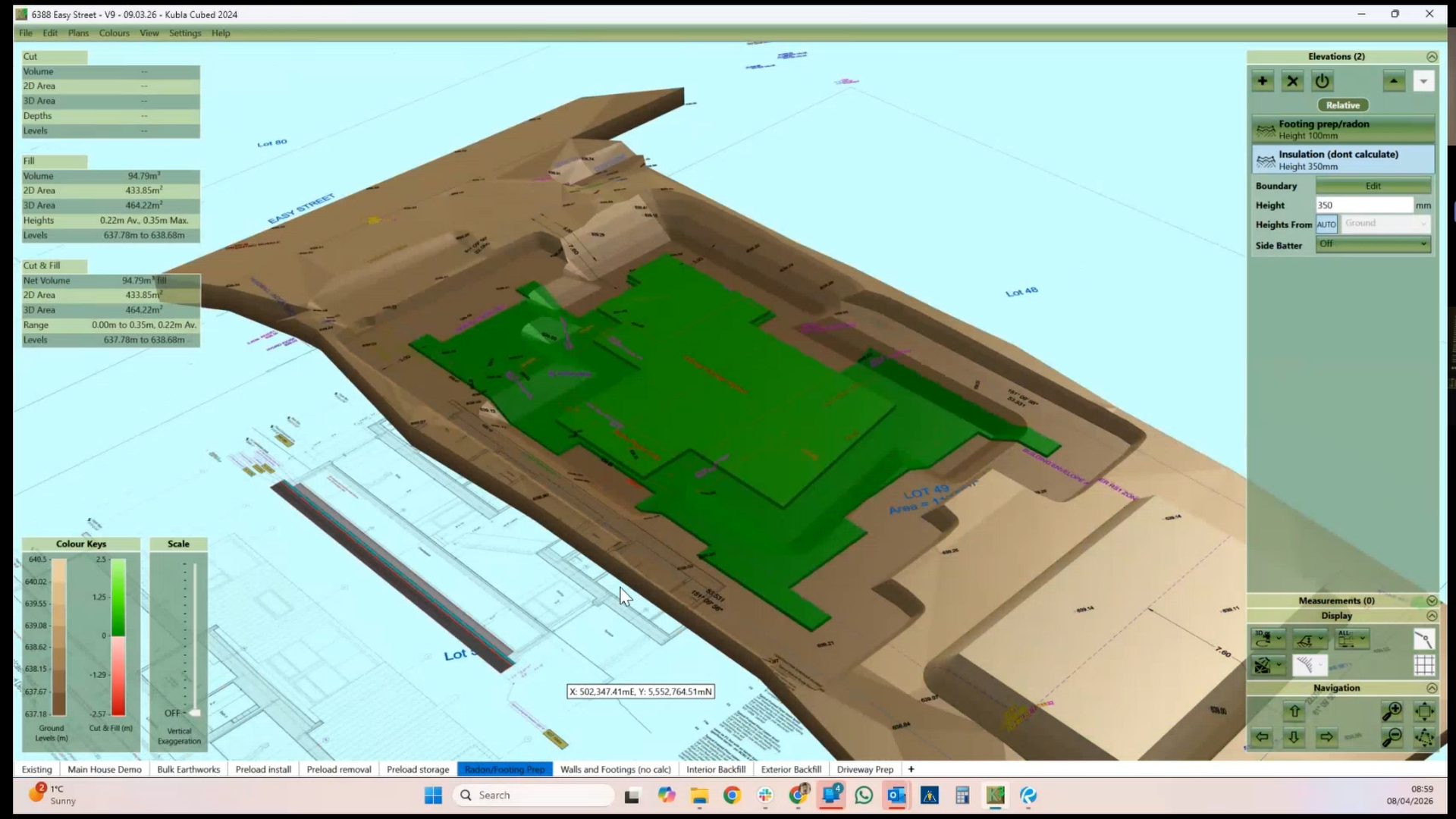
Radon/Footing Prep Phase
Two Raise elelments to define footing and insulation
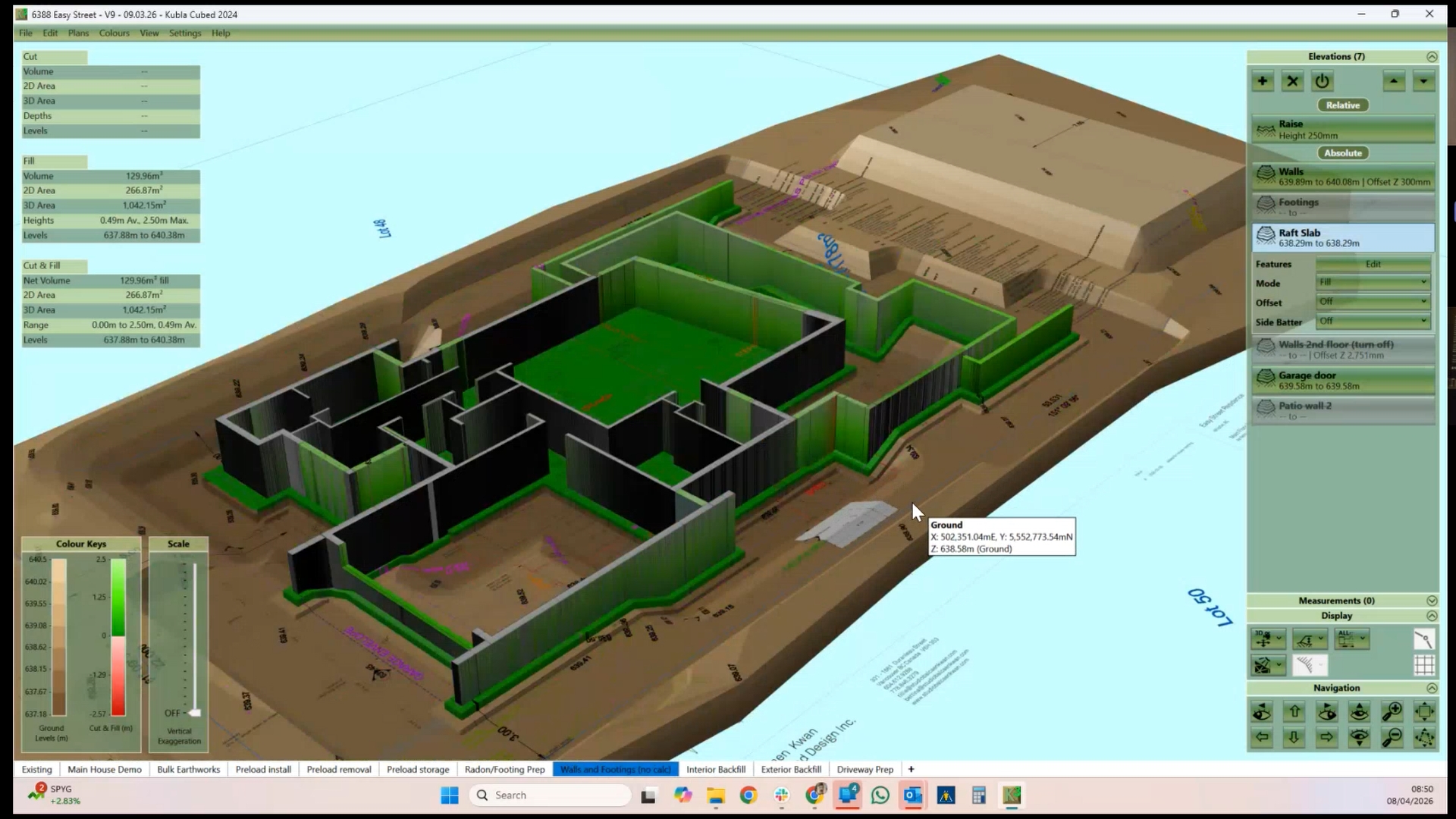
Walls and Footings (no calc) Phase
Defined surface with Raise and Feature Surface elements to generate a surface for subsequent phases.
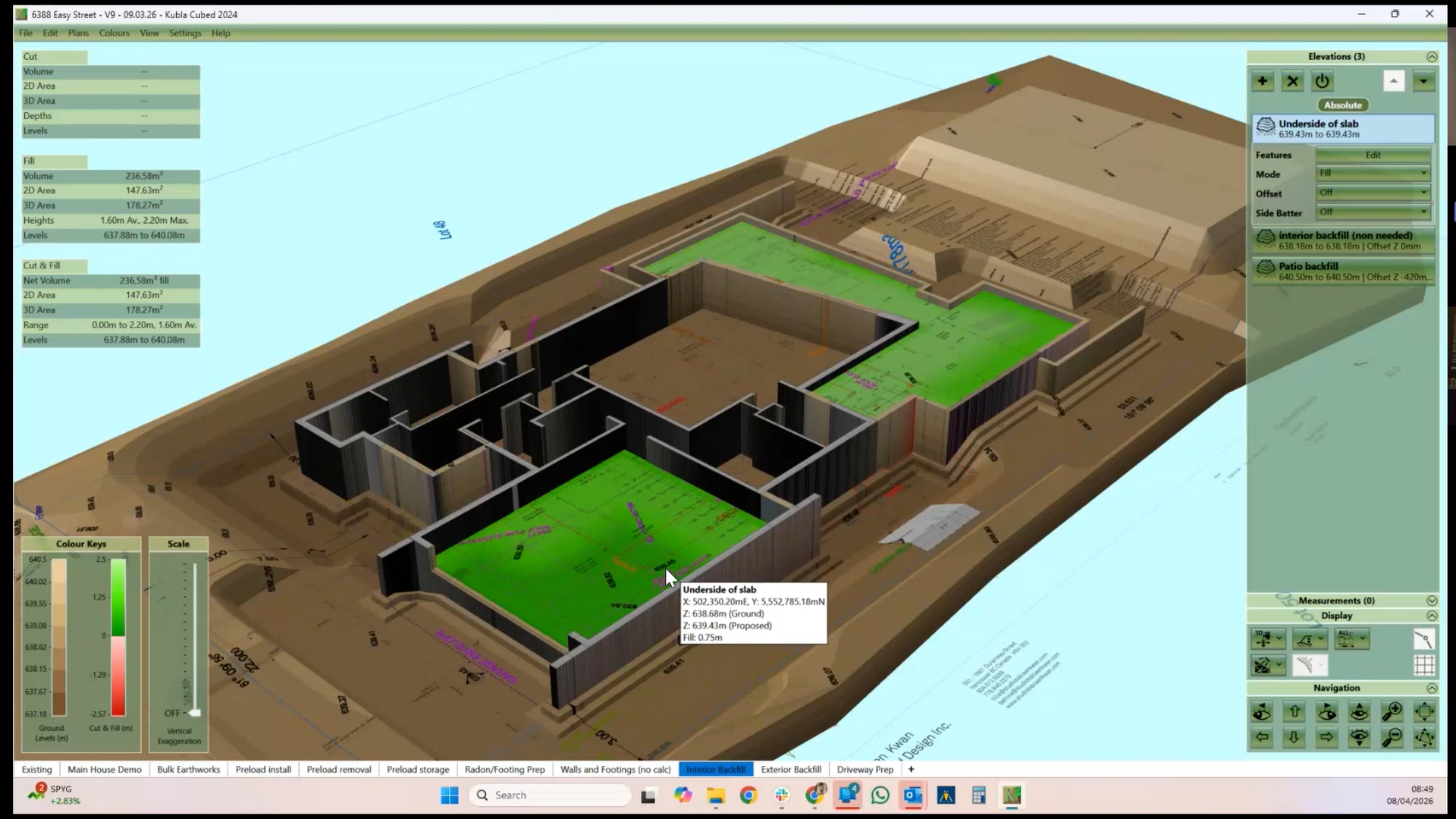
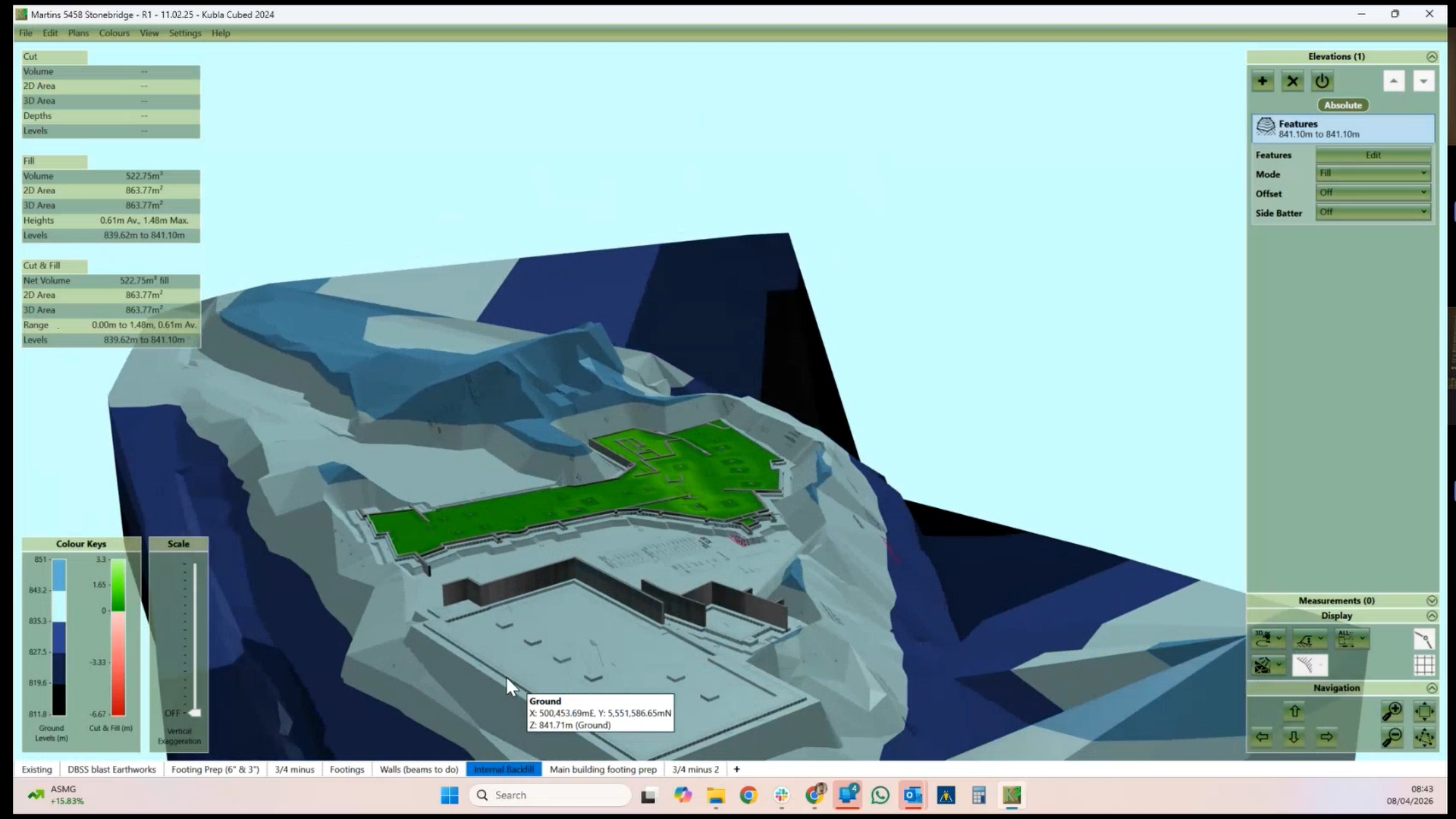
Interior Backfill
Feature Surfaces used to complete backfill.
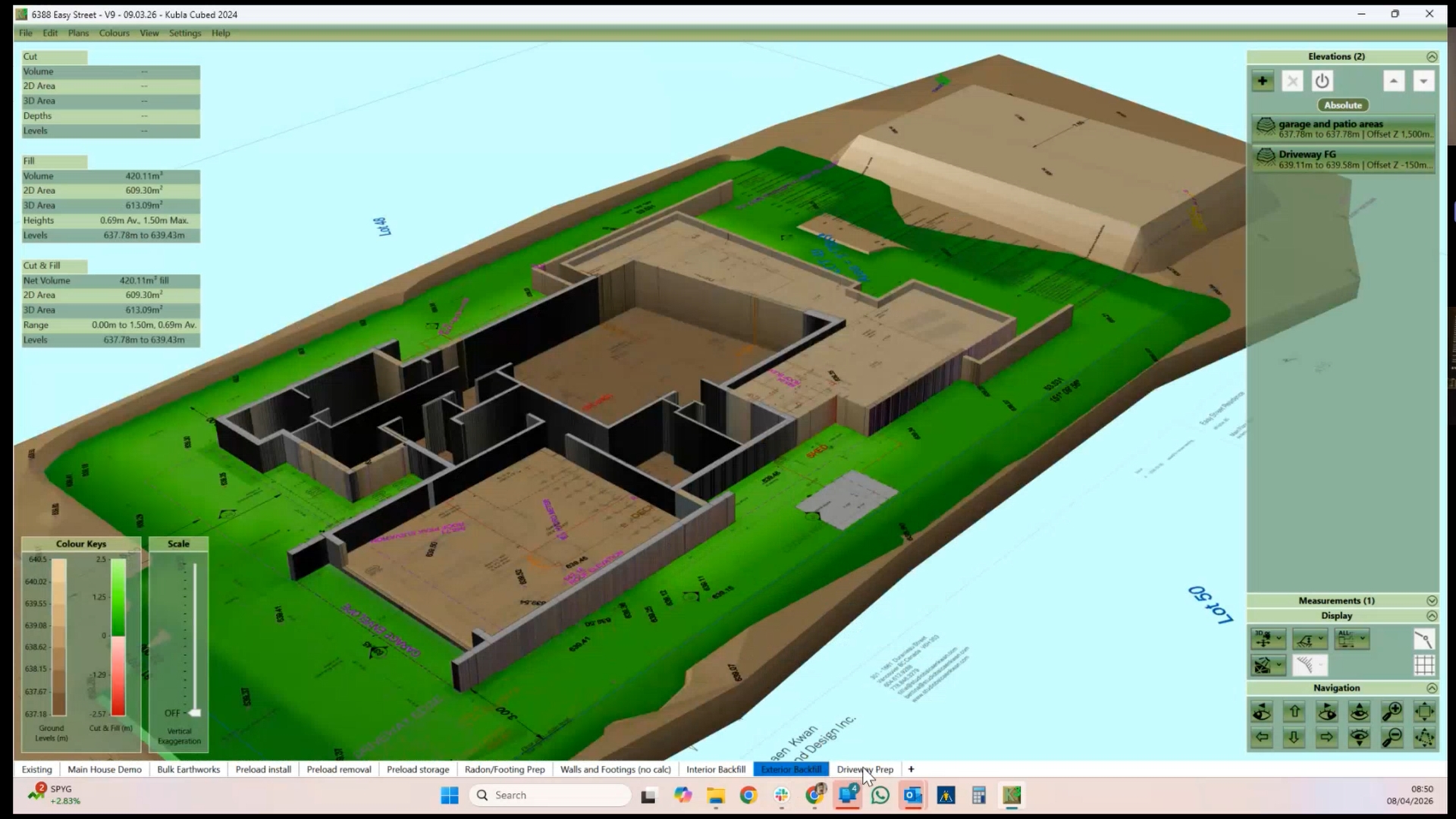
Exterior Backfill
Feature surfaces used to calculate exterior backfill

Rendering of Building
Rendering of final building used check 3D model is correct
2. Preventing costly excavation mistakes
Early-stage modelling has helped identify and mitigate issues that might otherwise be missed during traditional estimating workflows, including:
-
-
- 2:1 footing slope requirements
- Property boundary constraints
- Geotechnical approval needs
-
“The visuals help clients see their options early — and time is money,” Martin said.
This enables him to do direct comparison of construction approaches, such as:
-
- A single concrete pour requiring complex excavation
- A simplified excavation approach with staged concrete pours
“Each method has its own constraints,” Martin explained, “presenting these options to the builder can really help establish a good rapport early on as they try to achieve the same end goal.”
Competitive Advantage: How Corona Excavations wins trust with accurate 3D modelling
“If we hold a higher standard than competitors, we start to set the standard.”
Kubla Cubed has strengthened Corona Excavations competitive positioning during tendering by improving both the quality and clarity of bid submissions.
The software helps demonstrate:
-
-
- Strong technical diligence
- Better risk anticipation
- Clear construction logic
-
For Martin, Kubla Cubed simplifies complex excavation workflows while providing clear visual insight at every stage of a project.
“Being able to show this visually to clients is clutch.”
For Corona Excavations Ltd, Kubla Cubed enables faster decisions, clearer communication, and greater confidence from bid through to construction.
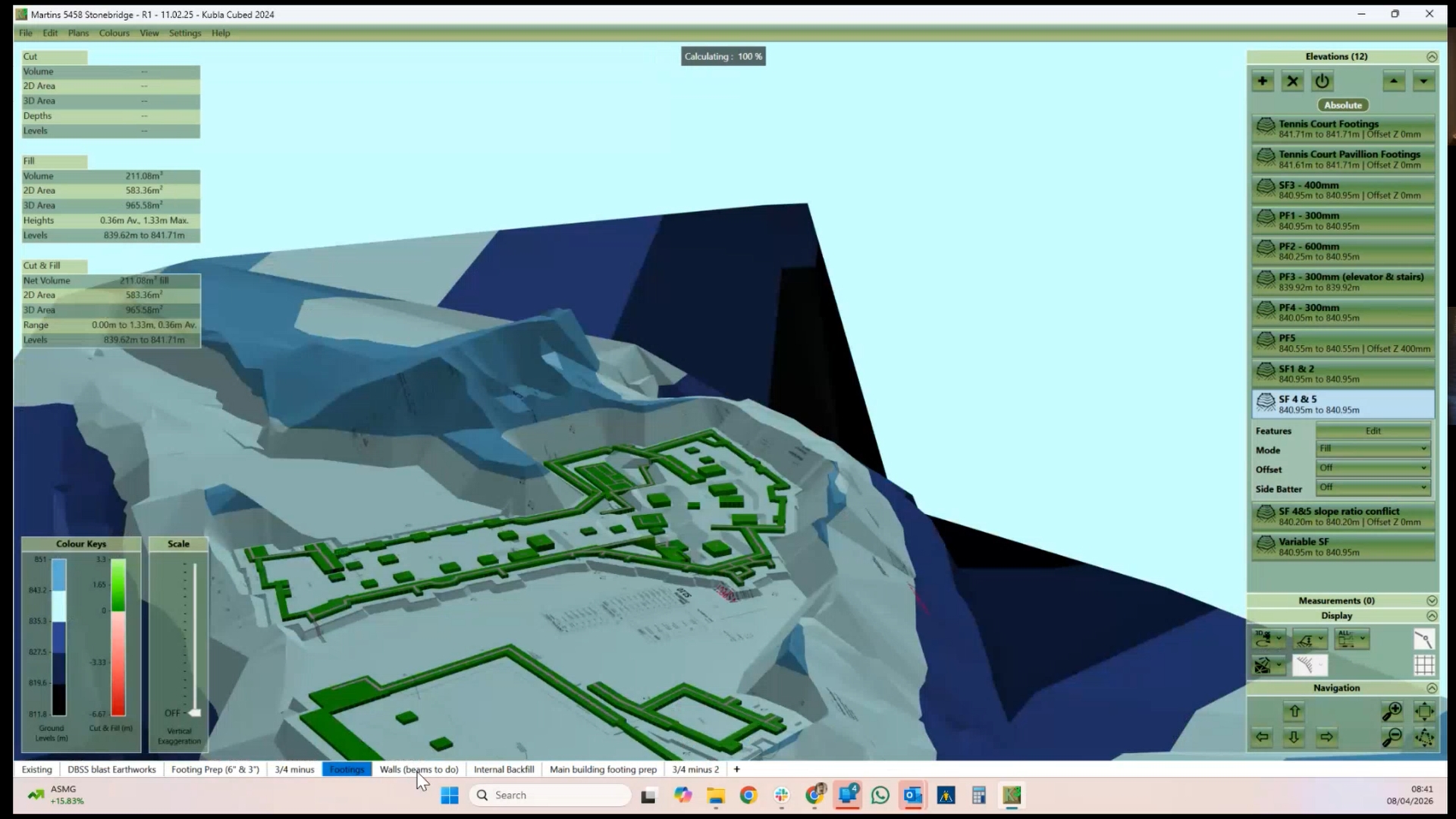
Image: 3D model in Kubla Cubed
Ready to Explore?